The method
How we choose the daily ten
One palette, one room story, and a set that has to survive a cohesion check before anyone sees it. Here is the whole standard, including how a day fails.
Why ten
Ten is enough to finish a surface and few enough to hold in your head. A shop with four thousand items asks you to do the editing. A set of ten says: this decision is already made, and here is what it looks like.
The count is a guide we work inside, not a number we chose for marketing. Most mornings the room is about ten in-stock pieces, sometimes one more or one fewer. We would rather let the room be what it needs than pad the set with a near-duplicate candle to hit a number.
Four roles every room reaches for
A vignette is not a pile of nice objects. It is a small cast, and each part has a job. When stock allows, every room includes these four.
- AnchorFurniture or a substantial accent that gives the surface weight — a cabinet, a console-scale piece, a lantern pair.
- FlameWarmth for the evening. Cream, black, or clear neutrals — soft light rather than novelty color.
- GreeneryLife and height. Fern, eucalyptus, boxwood — so the surface reads lived-in instead of staged.
- Word accentOne quiet sign or phrase. Personality that does not shout over the materials.
The remaining pieces fill the same mood — trays, rings, soft ribbon, a second green, an urn. They are not filler. They are the reason the four leads look intentional instead of accidental.
Palette before product
We name the color story before we pick anything. Greige Calm leans cream wood, soft black, and linen. Quiet Greenery brings sage, fern, and charcoal. Warm Textures favors cognac, tan velvet, and oak glow. Evening Light stays flame-forward with cream and charcoal. Soft Layers works in ivory, taupe, and pale wood.
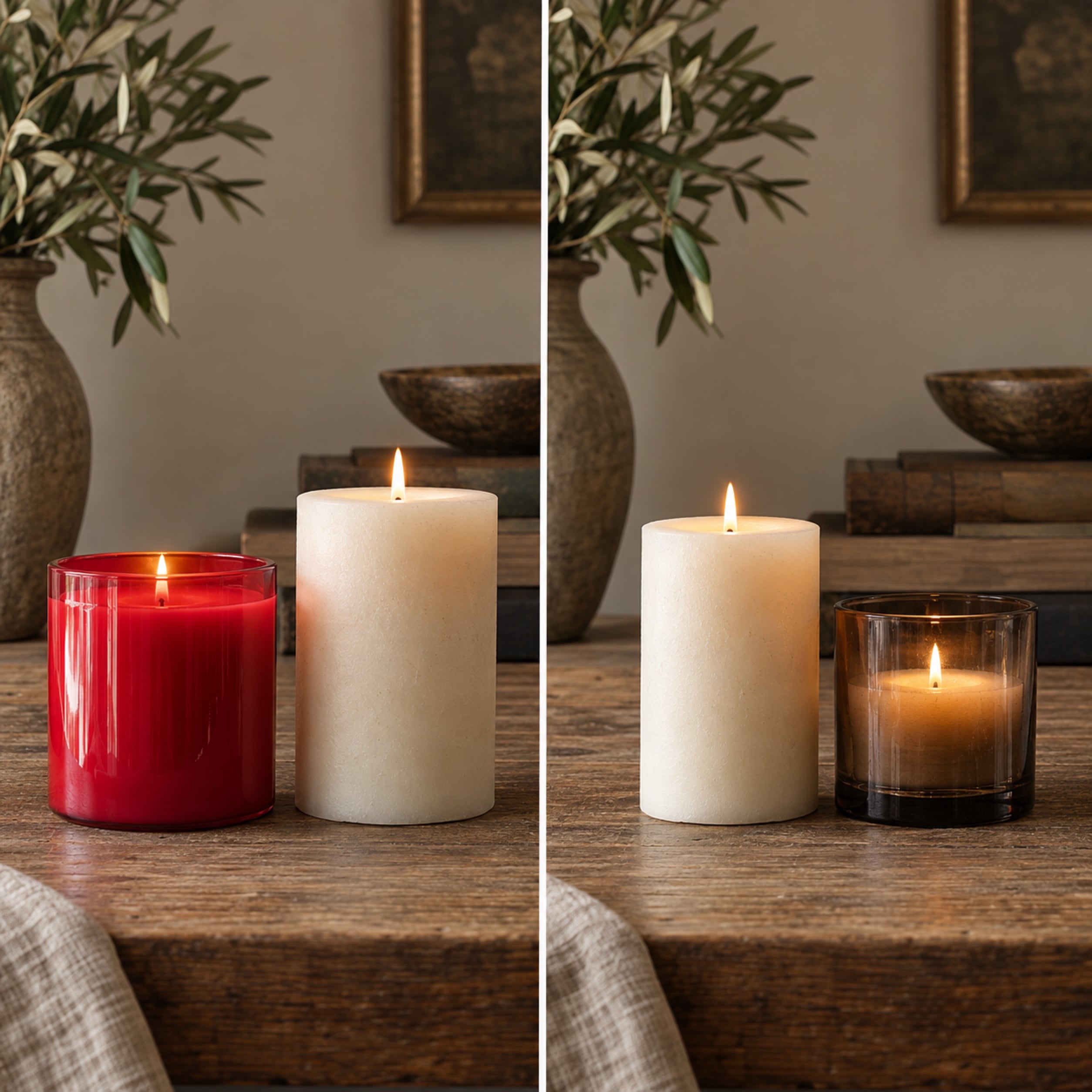
The test is simple and unforgiving: if the palette cannot be named in one breath, the room is not cohesive. Two competing brights in one small set — an orange spray next to a red pillar — is marketplace noise, and it fails regardless of how good either piece is on its own.
How a day fails
Rejecting a room costs a morning. Publishing a bad one costs trust, so we reject. A set does not go live if any of these are true:
- The palette cannot be named from a single glance
- Two saturated warm brights are fighting each other
- Holiday, Halloween, or harvest novelty leaked into a year-round room
- The pieces read as unrelated aisle grabs with no shared room story
- The title or mood line is generic and ignores what is actually in the set
- A shopper would have to remove half the bag before buying it as a whole
That last one is the real test. The whole room is the stress test for cohesion: if we would be embarrassed to send someone the whole room in one box, the day is a failure even when every individual item is fine.
What we are not doing
We are not claiming a secret algorithm picked your décor. The taste is human, the rules are written down, and the set is reviewed against them. On days with a reason — a launch, a photograph, an intentional seasonal moment — the room is chosen by hand outright.
Prices always come from the live catalog. What you see is what the piece costs, and the set discount is applied by the shop, not by a code you have to hunt for.
Take the whole room
Shop one piece or a few if that finishes your corner. When the whole vignette feels right, take the whole room — the whole room — and the set is yours at twenty-five percent off. That is a reward for finishing the story, not a clearance coupon, and it is why the cohesion standard has to hold.
See it applied
The method changes shape depending on the surface. Read the living console, the entry moment, the dining tabletop, or the evening mantel — or browse all of the room stories.
See the method executed — today's ten are up.