Christmas guide
Bottle brush trees, and how to decorate with them
Small, bristled, and a little nostalgic. How to choose them by size and color, and how to group them so they look placed rather than scattered.
Bottle brush trees are small Christmas trees built the way a bottle brush is built. They fill a tray, line a shelf, or give a mantel its height, and they ask for very little.
Where they came from
The idea is simple. Bristles are twisted into a wire stem, then trimmed into a cone and set on a base. The story most often told is that Addis, a British brush maker, turned its brush-making machines to green bristle trees around 1930. It is a good story and a hard one to prove. Historians who have gone looking for the paper trail found it thin, so we tell it as a story, not a fact.
What came after is clearer. After the Second World War, small brush trees on simple bases became a mid-century Christmas staple, and people have collected the old ones ever since. The trees we carry are new, made in that old style.
Choosing size, color, and trim
Size. Ours run from about 4 inches to 20. Trees of 4 to 6 inches belong on a tray, a windowsill, or beside a lighted house. Trees of 8 to 12 inches hold a shelf or a side table. The tall ones, 15 to 20 inches, give a mantel its top line. Many come in sets of three, five, six, or twelve, which does the grouping for you.
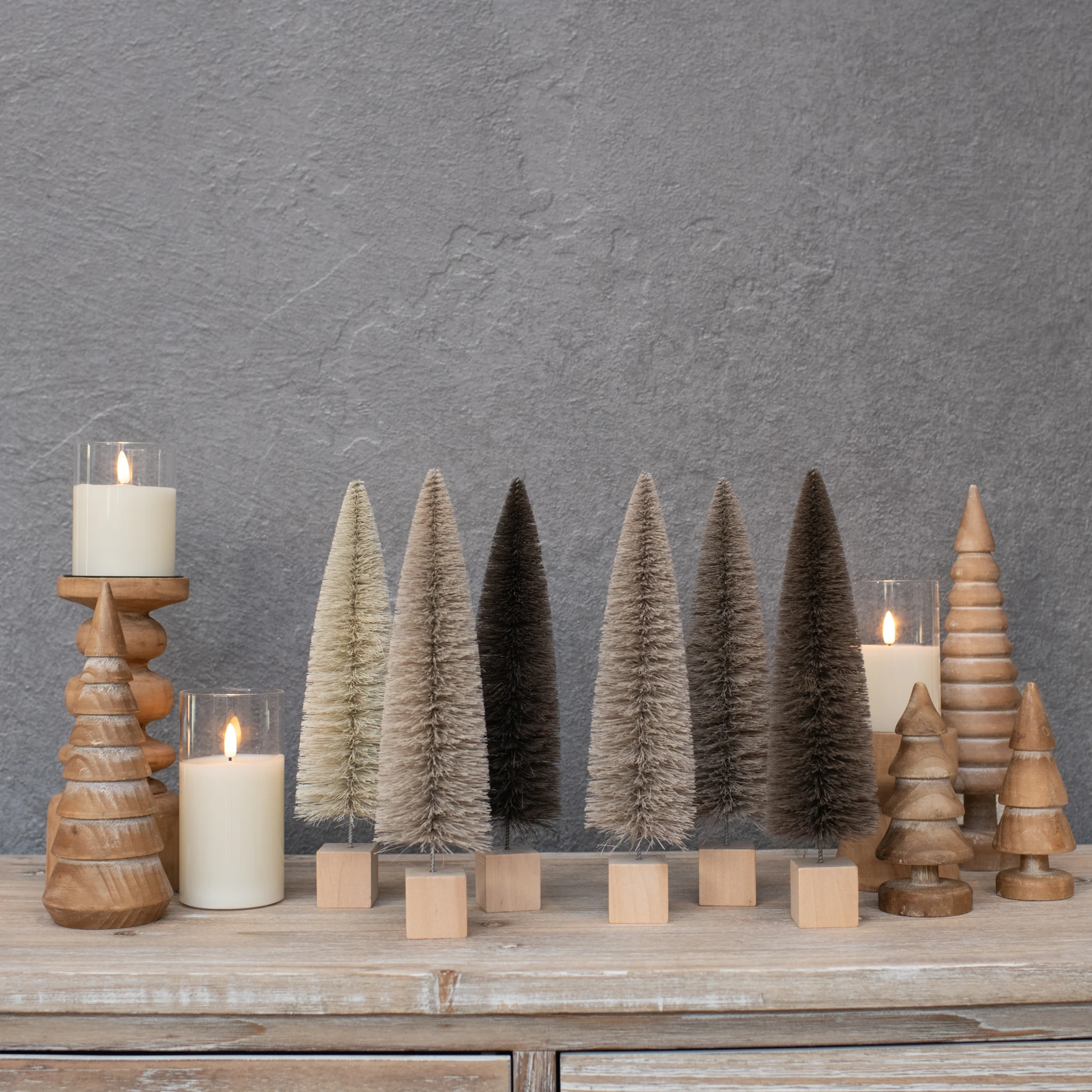
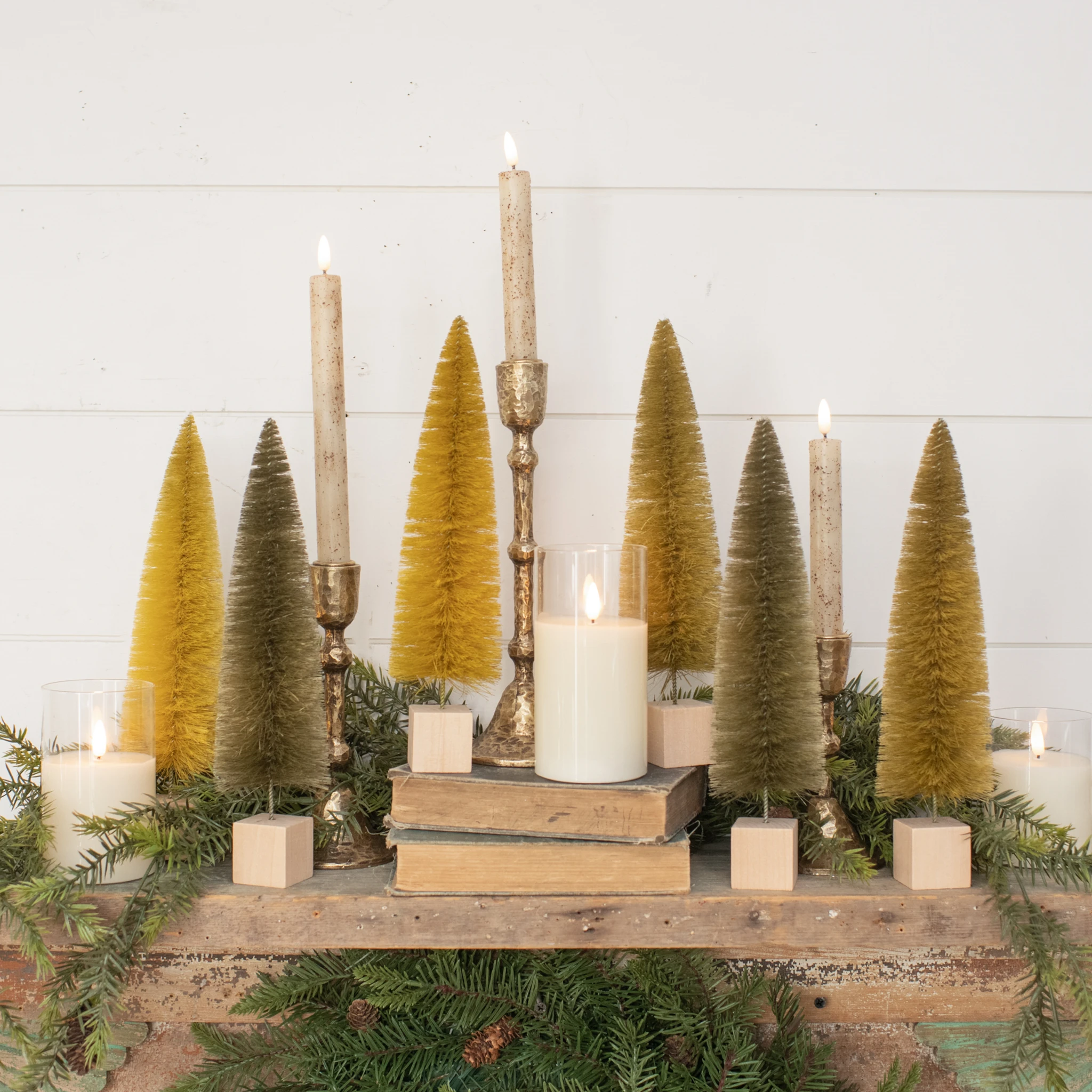
Color. Green is the classic, from deep green to snowy tips. Burgundy reads warm and a little old-fashioned. Cream, latte, and tan are the quiet choices, close to our Soft Layers palette of ivory, taupe, and pale wood. Then there are tonal sets: several shades of one color in one box, in green, blue, blush, or mustard.
Trim. Some trees come plain. Others carry jingle bells, small ornaments, glittered bulbs, or tiny mushrooms. Plain trees mix easily. Trimmed trees work best as the whole story, not one voice in it.
Material. Most of ours are listed as sisal, many on small wooden bases. A few sets are lighted, which matters after dark.
Snow-tipped trees in the shop now


How to decorate with bottle brush trees
Name the palette before you buy. The rule behind Today’s Room holds here: if you can’t name the colors in one breath, the group isn’t cohesive. “Snowy green and cream” works. “Blush, mustard, and blue” is three stories at once, and two bright colors on one surface start to argue.
Make a small forest, not a row. Use three heights and an odd number of trees. Put the tallest a little off center, set the others in front and to one side, and let them overlap. A straight line of matching trees looks like a store shelf.
On a mantel, keep the weight to one side. A cluster at one end, a candle or lantern toward the other, and real empty space between. On our year-round evening mantel we leave bottle brush trees out, because they say December. In December, that is the point. Let them lead, and check the mantel after dark with only the lights on. If the group still reads as one shape, it works.
Give a lighted house a few trees. One glowing house with three small trees beside it is a whole scene. It doesn’t need a village. Start with lighted houses and villages.
Contain the minis. Tiny trees scattered across a table look like clutter. Gather them on a tray, a cake stand, or under a cloche and they read as one piece.
Keep the dining table low. Use trees under about 10 inches so people can see each other, and run them down the center of the table.
Tonal sets, one color family each


Other tabletop trees
Bottle brush trees share the trees collection with feather, felt, rattan, paper, and ceramic trees. They mix well when they share a color. An ivory feather tree behind a few cream brush trees reads as one idea; the same tree beside mustard ones reads as two.
Care and storage
Dust with a soft, dry brush or a hair dryer on its cool setting. If the bristles flatten in storage, fluff them back with your fingers. Store the trees upright in their box or loosely wrapped in tissue, somewhere dry and out of direct sun, which can fade dyed bristles over the years. Keep them away from open flame. Sisal is a dry fiber, so a flameless candle is the better neighbor.
Common questions
Why are they called bottle brush trees?
Because they are made like a bottle brush: bristles twisted into a wire stem, then trimmed into a cone.
What size should I buy?
Measure the surface first. For a shelf or a tray, 4 to 8 inches. For a side table or console, 8 to 12. For a mantel, one or two trees of 15 inches or more with a few smaller ones, so the group has a top.
Can they stay out after Christmas?
The plain green and snowy ones can. Without bells or ornaments they read as winter rather than Christmas, so they can carry a shelf into January. Pack the trimmed ones away with the tree.
Are your trees vintage?
No. They are new pieces made in the traditional style. Older trees turn up at antique shops and estate sales if you want the real thing.
Keep reading
Small trees pair well with figures and glass. Read our guides to belsnickle Santas and kugel ornaments, walk through the Christmas house, or see how we choose the daily ten. Every guide is in room stories, and the trees themselves are in bottle brush and tabletop trees.
The trees are in the Christmas house.