Christmas guide
Dummy boards: the silent companions, and how to display them
Flat, painted, cut to the outline of a figure, and meant to fool the eye for a moment. Where dummy boards come from, and where to stand one this Christmas.
Dummy boards are flat figures, painted and cut to the outline of a person or an animal, made to stand in a room as if they belonged there. They began in Dutch and English houses in the 1600s.
What is a dummy board?
The form grew out of trompe l’oeil, French for “deceive the eye.” In the early 17th century, Dutch painters were making life-like interior scenes, and dummy boards turned the trick into something you could stand in a hall: life-size wooden figures of servants, soldiers, children, and animals, painted in oil and cut to shape. The fashion reached England soon after, and by the end of the century dummy boards stood in houses across Europe, the British Isles, and colonial America.
Most were made by sign painters, the same trade that painted the hanging street signs of the day. Some figures were painted on canvas first, then glued to the wood. Battens reinforced the back, and some boards stood on a small block at the base.
Why they’re called silent companions
Dummy boards had several jobs. They stood in corners and on stairways to surprise visitors. In summer, pairs of them, often children, stood in front of empty fireplaces to hide the hearth. Some may have been meant to give a would-be burglar pause. Their other name, silent companions, suggests that some simply kept people company. By the mid-1800s the fashion had faded, and the old boards are now museum and collector pieces.
Christmas boards today
The form has come back as seasonal decor. Our Christmas boards include Santas, snowmen, angels, reindeer and fawns, penguins, gingerbread figures, sheep, and a nativity. By their listings, most come one of two ways: metal, or paperboard on MDF. They are new pieces made in the old form, not antiques.
Not every board is for Christmas. Sheep, rabbits, and chicks stand with our year-round frames and mirrors, and the fall frames and journals have a Halloween witch and a pair of cats on a fence.
Santa boards in the shop now
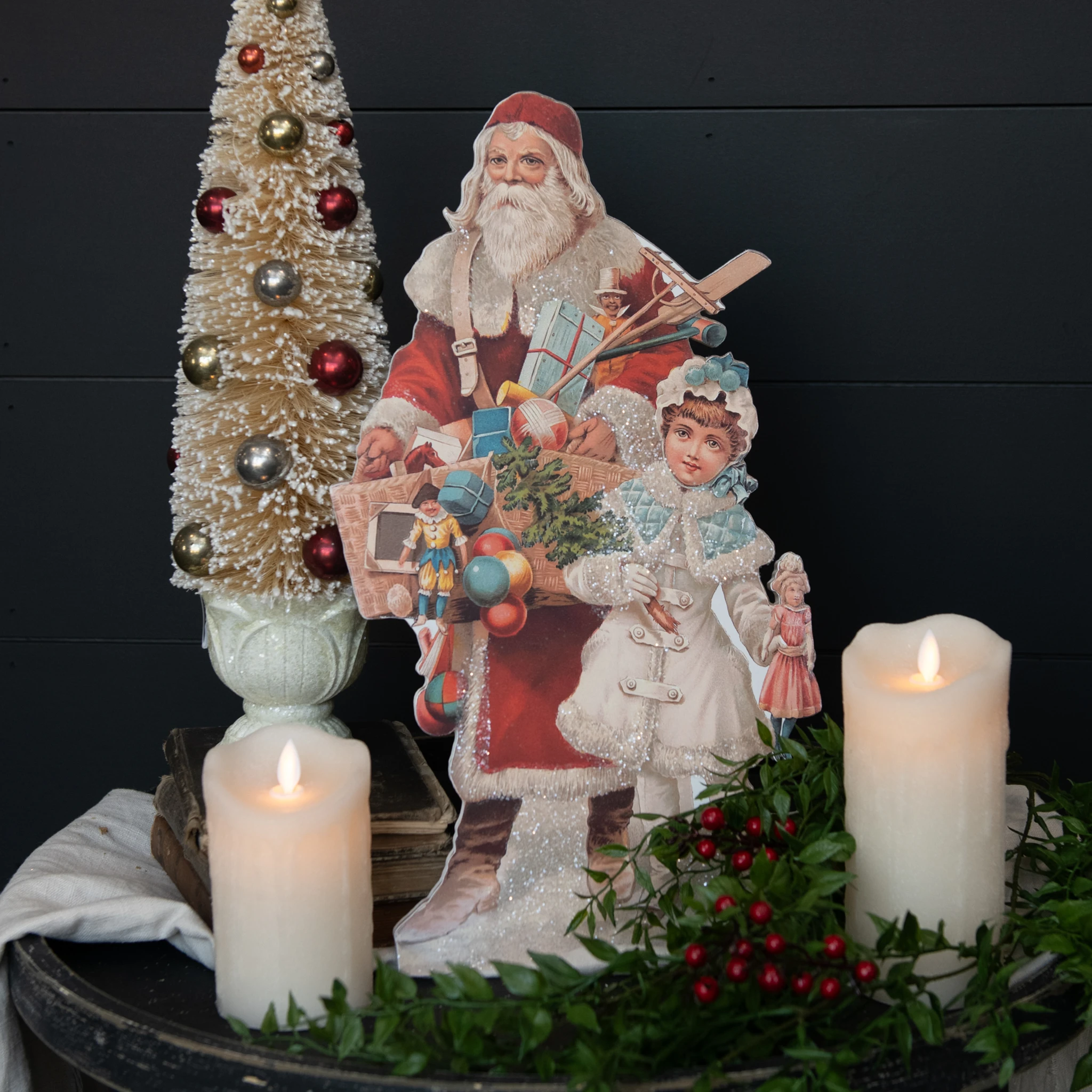


Choosing size, subject, and material
Size. Ours run from about 12 inches to 45. Boards of 12 to 20 inches stand on a mantel, a shelf, or a stair tread. Boards of 24 to 36 inches stand on the floor or the hearth. The largest, 40 inches and up, want a corner or a landing of their own.
Subject. Choose the figure for the place. A Santa or an angel suits an entry. Children, sheep, and deer feel right on a stair. A snowman or a penguin is lighter, good for a family room or a child’s room.
Material. Each listing says whether a board is metal or paperboard on MDF. Treat both as indoor pieces unless a listing says otherwise, and keep the paperboard ones dry.
How to display dummy boards
Stand it where a person might stand. The trick only works when the figure is somewhere a figure could be: the foot of the stair, the end of a hall, beside a door, the corner of a landing. In the middle of an open wall it is just a cutout.
Give it low light. The originals fooled the eye in dim rooms. A lamp nearby, or a flameless candle, and the board reads best at dusk.
Use the hearth only when it is cold. A board in front of an unlit fireplace is the oldest use there is. Never stand one in front of a lit fire.
On a mantel, one is enough. Set a smaller board a little to one side, let greenery overlap its edge, and keep flame well clear of it. The evening mantel rules still apply: weight to one side, and a third of the shelf left empty.
Pairs flank a door. Two boards on either side of an entry echo the old fireplace pairs.
Sheep, for Christmas and after


Care and storage
Dust with a soft, dry cloth. Keep paperboard boards away from damp and spills, and keep every board out of strong sun, which fades color over time. Store them upright or flat in their box, with tissue or a cloth over the painted face so nothing scratches it, and don’t stack anything heavy on top.
Common questions
Do dummy boards stand on their own?
Most of ours are listed as freestanding. On a mantel or a stair, make sure the base sits fully on the surface, and keep larger boards out of walkways where they can be knocked over.
Can dummy boards go outside?
Their listings describe indoor spots: a mantel, a hearth, a step. Unless a listing says a board is made for outdoors, keep it inside, and keep the paperboard ones away from any moisture.
Are dummy boards only for Christmas?
No. The originals stood all year. Sheep, rabbits, and chicks work from spring on, and a Santa can stay up until the tree comes down.
Are your dummy boards antiques?
No. They are new, made in the old form. Antique dummy boards are found in museums, historic houses, and private collections.
Keep reading
For a figure that stands on the mantel instead of the floor, read our guide to belsnickle Santas. Walk through the Christmas house, see how we choose the daily ten, or browse all of our room stories. The Christmas boards themselves are with the Christmas frames and journals.
The Christmas boards live with frames and journals.